Section Five
Module 20: Methods for Cross-Cultural Communication Care
-
What techniques can I use to provide the best possible culturally and individually appropriate care for this client?
-
After working with the material in this module, readers will be able to
select from among 10 specifically cross-cultural techniques to provide high-quality individualized communication care to all clients
incorporate the four universally designed or multi-cultural approaches from Module 18 into cross-cultural care with individuals
use appropriate client-centered referrals to other clinicians, rarely, as a possible final option for helping clients obtain the care they need
Drawing on a wide range of evidence-based, cross-cultural, and individualized clinical techniques allows us to provide high-quality care for communication, swallowing, and related needs with every client and every family.
Be sure you understand the distinctions between “multi-” situations and “cross-” situations, and the constructs of universal needs and specific needs, from Module 15, before you try to read this module.
We have discussed throughout this website that all of our clinical interactions will be cross-cultural or cross-identity to some greater or lesser extent. Some therapeutic bridges will be longer or more complex than others, yes, but none of our clients are the same people we are.
The cross-cultural or cross-identity techniques described here in Module 20, therefore, are not special techniques to pull off the shelf when we have decided that a client is “different” or “multicultural” or “culturally and linguistically diverse.”
Instead, the options we will discuss represent methods that can help you meet each client’s needs and every client’s needs, whether that client differs from you a little bit along a few continua or differs from you by a lot along many continua.
To start, we will think about 10 specific techniques for individualized, personalized, cross-identity, or cross-cultural clinical care (see the first 10 options listed in Box 20.1). We will then briefly remind ourselves of the four universal or multi-culturally appropriate clinical methods from Module 18, all of which are also excellent options as we work with individuals (listed as numbers 11 -14 in Box 20.1). Finally, we will think about the possibility of referral to another clinician.
That’s a total of 15 possible specific methods or techniques for your clinical work with individuals! I hope at least a few of them might feel like good fits for you and might help you to provide the best possible individualized and culturally appropriate care with each of your clients — again, not because we label some people as “other” or “different” but because we understand that every client deserves our best possible culturally and individually appropriate clinical service.
Box 20.1. Fifteen Options, Techniques, and Methods for High-Quality Cross-Cultural and Individualized Communication Care
Verbalize the universal and the specific as part of writing every goal.
Greet the client with a specific question.
Have clients bring their own (and then you bring others like it next time).
Build a multi-cultural materials room, bring cross-cultural options to the session, and allow the client to choose.
Use personalized electronic stimuli (carefully).
Focus on the “A” Words: Ask, Act, Accept, Alter, Adapt, Adjust, Accommodate.
Structure therapy around the client’s entire community of care (Watermeyer, 2020).
Approach all client care as cultural adaptation research (Muñoz, 2017).
Consult and collaborate with more cultural informants and cultural brokers.
Practice trauma-informed care and hope-informed care.
Use the universal “Yes, and” approach as a specific technique.
Use ethnographic interviewing.
Use dynamic assessment.
Use principles from culturally-sustaining group therapy.
Use a specific, appropriate, ethical referral to another clinician.
1. Verbalize the Universal and the Specific as Part of Writing Every Goal
Before we develop any goal or any intervention plan for any client, we need to be able to identify the relevant human universals and also the relevant specifics from the client’s cultural or identity-related context. This principle shapes all our language-specific goals (e.g., which phonemes, morphemes, syntactic structures, and semantic items to teach, and why), as Module 21 addresses in detail. It is also critical for everything else about a client’s speech, voice, literacy, or communication that we might be proposing to change. Taking the time to identify and verbalize both the underlying human universal and also the relevant individual specific details for every goal helps to ensure that we are not teaching our own familiar specific details as if they were a human universal or as if they represented a relevant specific detail for another person.
Consider the following fragments of example therapy goals. Have you ever used anything similar? Which human universals do each of these actions represent? How are those universals realized in the specific communities you have encountered?
… will initiate communicative interactions…
… will exhibit turn-taking and topic-maintenance behaviors in conversation…
… will demonstrate reduced vocal loudness…
… will use 2- to 3-word utterances to express individual wants and needs…
… will describe the function of common household items, to facilitate naming of those items…
Do you see some of the important issues here?
All conversations are intitiated by someone, and all conversations include turns from two or more participants, to start with the first examples, but many details are culturally determined, represent different places along Hofstede’s (2011) dimensions, and are influenced by Morgan’s (1996) identity dimensions (e.g., age, gender, education). Who is allowed to initiate a conversation with whom? How exactly are conversations initiated between which partners and under which circumstances? The key here is to be sure you understand those details from the client’s world and plan to teach the client to implement the details that will be appropriate for their life, not for yours. We do so by stating the universal and separately stating the specific, as a technique that helps us be sure we are not conflating the two or teaching our own specific as if it were a universal.
All speakers use a range of quieter to louder productions, to take another example, but why would we be targeting reduced vocal loudness, and what will that change create or imply for this client? Does loudness convey authority, power, masculinity, lack of control, self-actualization, or a risk factor for vocal nodules, in this person’s world? What are we doing to a person’s roles in his family or his work group, or to his hard-fought efforts to be perceived the way he wants to be perceived, if we ask him to speak more quietly? The universal, which we must be able to state before we write any goals about vocal loudness, is that people can produce voice using a range of loudnesses. The specific, which we also must be able to state before we write any goal for any other person, must incorporate how loudness is used and interpreted in that client’s world.
Continuing with our examples: stating individual wants and needs, versus being able to function as part of a family that makes group-based decisions, is a very culturally influenced goal that is much more important for clients (and clinicians) who value individualism than it is for those who value collectivism. And our professional assumption behind teaching clients to use a functional-description strategy as a solution to what we or they perceive as their word-finding difficulties is probably that the description substitutes for the name and/or will facilitiate retrieval of the name — but let’s divide between the universal and the specific here, too. Universally, nouns can be named and functions can be described. But specifically, silence if you cannot be succinct might be important to a client, and taking up other people’s time with a tangential stream of round-about words might be perceived as self-centered, rude, or simply inappropriate, not as a reasonable communicative strategy. A man who worked outdoors to provide for his family may know neither the name nor the function of items that you assume to be “common household objects,” or the entire family might consider them women’s things that he should not be expected to discuss even if he does know. We cannot mistake the universal (names exist and functions can be described) for the specific.
The basic point here is that cross-cultural communication care requires us to be able to specify why we are targeting any goal generally (the human universal that this category of actions represents, given the even larger human universal that people use speech and/or language to communicate with each other) and also to specify precisely what we are seeking to change and why for any individual. This relatively brief action on our part, the technique of verbalizing the human universal and also asking the client or the family about how they want to realize their specific version of that universal, is a crucial and critical feature of cross-cultural clinical practice. If I could re-design all the clinical templates in the world, each clinical goal would be described in terms of the client’s current ability; the category-level human universal; a description of the specific version of that universal that the family and the client perceive as typical and appropriate in their lives and/or as appropriate for the client; and then the specific short-term objectives and long-term goals for the client’s therapy.
2. Greet the Client with a Specific Question
Our clients and their families show us many things at the very beginning of every session that can serve as building blocks in our cross-cultural bridges, if only we make the effort to notice. They are chatting about something in the waiting room or looking at something on their phone in the waiting room, or they get up from the waiting room chair very slowly. They have a jeweled pin on their lapel or they are wearing red shoes. The client or her parent or her grown child is wearing a uniform shirt from work. There is now a third IV pole next to the adult’s hospital bed, or the child is at a different table when you enter their classroom. If nothing else, they have lived somewhere between a few hours and a few weeks of their own life since you saw them last.
To start every session, notice any of this and ask a specific question about it. Alternatively, train yourself to remember something the client mentioned last time so you can start with it this time. Either way, with the same kindness and care in your voice and in your smile that you would use with your very favorite people in the whole world, greet your client with a specific comment (“Something fun on your phone?”, “No rush, are your knees sore today?”, “Looks like they brought in some more medicines?”, or “So how did that party end up going?”) instead of or after the generic “How are you today?” And keep going: Make the effort to create a full conversation about this topic. Ask follow-up questions, and keep accepting the client’s answers. If the thing you have noticed is something that differs from you or that you do not have the cultural background to understand, you can ask and learn, with kindness, acceptance, and cultural humility: “That fabric is so pretty! Does it have a special story?”
3. Have Clients Bring Their Own (and Then You Bring Others Like It Next Time)
Now that you have some goals and some created a specific opening conversation with client, you will move into some clinical tasks or activities, probably requiring some materials of some sort. Where will those materials come from, and how can you ensure that they are a good fit for the client’s specific needs?
One good option is to have the client bring their own. Do you need a culturally-appropriate toy to play with, an identity-appropriate book to discuss, or something for the client to eat or drink during your session that will be familiar and comforting to them? Whatever it is you need, consider having the client bring their own. One way to match what clients need is to allow them to show us, rather than presuming that we could possibly guess ahead of time what will be a good fit for another person.
Bringing their own conversational partner often works well, too, as a variation on the same “bring their own” idea. Instead of assuming that we are the best possible conversational partner for a client, we can ask them to bring a friend or a family member, positioning ourselves as a communication strategies coach and allowing them to serve as their own experts about their culture, values, beliefs, religion, and so on.
We can also learn from what we see in the first few sessions; believe that the client needs, wants, and likes these things; and try to bring something similar in later sessions, to take the burden of providing supplies back off the client and to introduce some necessary variety into our sessions.
4. Build a Multi-Cultural Materials Room, Bring Cross-Cultural Options to the Session, and Allow the Client to Choose
Sometimes we need other kinds of materials: picture cards, word lists, sentences, story starters, reading passages, etc. If the client cannot bring their own, or if your professional expertise is an important part of identifying appropriate materials, then plan to take more than you need and select a subset with the client during your session.
You probably do something like this already. You might take the farm toys and also the kitchen toys so the child can choose, or you might bring two magazines and have your adult client select one article to work with. As a cross-cultural bridge-building and therapy technique, we do the same thing more often and more conscientiously. Think about culturally-influenced variety as you stock your materials room, and then select options for each session by thinking about the client’s possible assumptions, experiences, or interests, not yours.
If your community includes families from Hmong, Mongolian, and Mexican backgrounds, for example, you can easily stock your materials cabinet by picking up flyers from the smaller local grocery stores and by collecting handouts from your public library that are intended for those communities. Stop in to any community agency that serves veterans or serves tribal elders or serves foster families, and pick up their flyers to use as conversational materials during speech therapy. Spend your small annual materials budget on online subscriptions to European magazines, a hard-copy physical newspaper from São Paulo, or an international snacks-box service (re-stuff the empty packets with cotton balls to re-use them). Given that people have a range of skin tones, buy some FisherPrice people with a range of skin tones. Given that people’s bodies differ, populate your toy box with some smaller dolls, some rounder dolls, and some of the many available dolls that use wheelchairs. Build your library of books by selecting international wordless picturebooks, which show a range of culturally influenced artistic and architectural styles. Curate a library for yourself of books that are either for or about people with a range of physical and cognitive abilities, or select books about specific cultural backgrounds from a source such as the Social Justice Books project.
Then, as you select things from your collections to take to an individual session, take a range of options, including some that you are guessing might match the client’s experiences or interests and some that reflect your best and most respectful attempts to consider the client’s places, not your places, along the many relevant continua [i.e., think in terms of Morgan’s (1996) identity dimensions, or think in terms of ideas about which foods, clothing, sports, or other activities you think you know might feel familiar to this client]. The client will be drawn to some of them more than others, for any number of reasons. Use those materials in your session, and use what you have learned when you select your range of materials next week.
(Be ready, by the way, for clients to make choices that do not fit with your stereotypes. Were you assuming that the child from a certain background would be interested in a certain sport, or that a man or a woman would be interested in certain kinds of activities? Seeking to provide clients with specific individualized choices does not mean requiring clients to fit into our preconceived or stereotyped boxes, and many people enjoy learning new content about new things as a side benefit of their therapy sessions. The key is always that someone who is looking for something familiar that does mirror their experiences should be able to find it in the options you present, if they want to, not that everyone must limit themselves to fit our stereotypes.)
5. Use Personalized Electronic Stimuli (Carefully)
If you use electronic stimuli during your session, rather than physical dolls and paper magazines, you have a truly infinite set of personalized stimuli at your fingertips, including those that are a perfect match for your individual client’s specific cultures, identities, traditions, and preferences. The key here is to make sure we are using good materials: not stereotypes, not websites that a child’s family has prohibited, and certainly not any problematic AI-generated material.
For conversation-level practice in language, fluency, or voice, for example, a child’s parent can show you which media, pop culture, sports, or music websites the child is allowed to access. With parental oversight, adolescents can show you which sites or social media feeds they follow. Older children and adolescents can probably access their schoolwork on their phones, if anything from school interests them or if you want to use curriculum-based materials. Adult clients, similarly, can select material from the news or entertainment sources that they tend to follow, or they can use their phones to access information from work, their photographs, their calendar, and many other personal materials that reflect their lives perfectly, all of which can serve as the basis for communication care sessions that center their cultures, identities, traditions, and preferences.
For some clients from some backgrounds, you might also be aware of speech-therapy websites that provide materials tailored to groups such as persons from Latin America or African American children. Be careful that such materials are not perpetuating stereotypes; they need to be correct matches to your client’s background, experiences, and identities, not problematic or incorrect overgeneralizations. If they are a good fit, they can be a useful part of your sessions, and they might be worth seeking out.
Beyond currently existing materials, or when you need more specific stimuli to address a certain speech or language target, we can also use artificial intelligence systems to produce word lists or picture stimuli that are appropriate for a specific speech or language target and that are tailored narrowly to a single client’s specific cultures, traditions, or preferences. Simple prompts such as the following, and many variations, can be used repeatedly during a session, because they generate stimuli almost instantly.
show me 12 English words about animals that all start with an S-blend, are related to Brazil, and are appropriate for a child
show me 12 phrases in English that all include a regular simple-past verb, are about the Diné people, and are kind and nice, and also show me the Spanish translations of those phrases
show me 12 simple line drawings of words related to Korean food or cooking
I tend to request “kind” words or words that are “appropriate for a child” almost always; requesting “adult” examples or “a range of examples” can produce violent or inappropriately sexual options. With most clients, I am also very careful to make sure I see everything on the screen before I let them see or share the words with them. If your prompt requests 12 words, as in these examples, you can drop two inappropriate ones and still have the 10 that you might be looking for.
Cultural humility and centering your client’s preferences are also necessary here, as are your simple kindness and gentle curiosity about the client’s world. And, again, your goal is not to limit the client to a stereotype; we do not say “You look Korean, so let’s focus on Korean cooking.” Your goal is to structure each client’s therapy sessions around topics that matter to them or that interest them, using examples of those topics that feel familiar to them and allowing them to help you generate the prompts you will enter into your AI. Start with a couple possible categories (“We need some words to work with today — would you like to do foods or sports?”), and then build on the client’s answers (“Food, okay, perfect; should we do Korean foods or something else?” if the client is Korean American, or “Sports, cool, what sports does your family like?” with almost anyone). When you have exhausted what you can do with those words, use something that came up in the conversation or ask the client where to go next, creating a sequence of prompts that reflects your client’s interests, not your choices:
show me 12 simple line drawings of words related to Korean food or cooking
show me 12 more simple line drawings of words related to Korean foods for the Lunar New Year
show me 12 short phrases that include words about the Lunar New Year as celebrated in Chicago
More complex prompts, including prompts requesting images, currently take a minute or two for AI systems to manage — although this technological limitation might not be true any more by the time you are reading this module! One option is to develop the prompt with the client and then use the wait time to practice something else or to play a guessing game about the potential result that will, on its own, provide the client with more practice. Alternatively, if the minute or so would be inappropriate downtime for your client, you can create personalized electronic materials ahead of time and save them or print them.
Working ahead of time means that you will have to take your best guess about the client’s preferences, rather than following their lead, but working ahead of time also allows you to catch and correct the errors that AI systems will generate. Some errors in AI output, as you have no doubt seen for yourself, are crucial and fatal errors that should lead you to delete the output immediately, especially in generated images. Most AI errors, however, are arguably manageable, as balanced against the advantages of using personalized stimuli for each client. Look carefully at the images below, for example; they include several problems, but they can also be meaningfully centered on a single person’s worlds and interests.
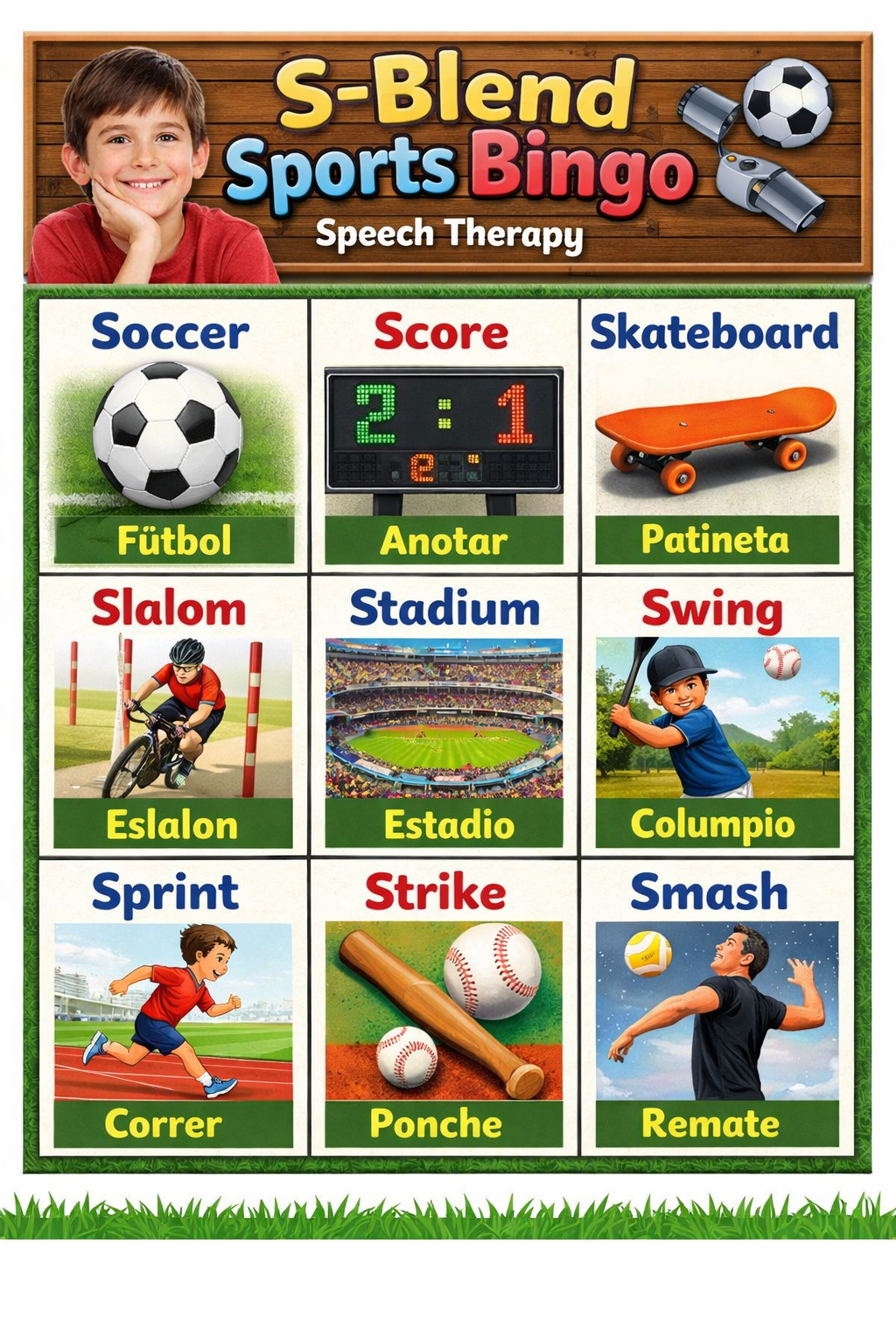
The first image below was created by ChatGPT in response to the following prompt: Create a bingo board for speech therapy in English with a 9-year-old boy. Use words that start with S-blends and that are about sports played in Mexico. Put a picture of each word and put the Spanish translation of each word. This image has several errors: the inclusion of the word “soccer,” which does not start with an S-blend (but which could be a reasonable review item or easy item for some clients); the made-up string “fütbol,” which does not exist, instead of the correct Spanish “fútbol”; and the unclear imagery at the top right and meaningless imagery in the scoreboard. Despite these errors, however, this bingo board would be quite reasonable to use in therapy with a 9-year-old boy who wants to talk about sports from Mexico — and it would only take a couple minutes to have the AI system fix the errors and to make the decorative image of the child more closely reflect your client’s visual characteristics (to create an almost literal mirror in your materials).
The second image below was created by ChatGPT in response to the following prompt: Create a page we can use in aphasia therapy to work on verbs. The page should show six pictures of an African American business woman doing something different in an office. ChatGPT did not use the visual features of typical speech therapy materials this time, the woman’s blouse is strangely neither tied nor stitched, and the visual noise on that whiteboard is imperfect, but this image also strikes me as quite useful for therapy with a client who is or was an African American business woman — and it is certainly preferable to using images of White men to work on office-based verbs or phrases with an African American woman.

Your Turn
Discuss these first five techniques, which focus on goals, greetings, and materials. Which are you using already? Which new ones appealed to you or would you like to try? Which new ones do not seem to fit your needs? Why?
Think about any one of your most recent clients. Identify one of these first five techniques that you did not use with that client, and think about how exactly you would you have implemented that idea with that specific person. Then think about some other recent clients and consider some other ways you would have implemented the same technique for different people.
I referred to Style’s (1988) notion of mirrors and windows in educational curricula as I described a couple of these options. Bishop (1990) expanded the metaphor by discussing the importance of sliding glass doors, instead of merely windows, in books for children. Other authors have also added to the metaphor, including by thinking of the curriculum as not only mirrors and windows but also as the maps of possibilities for their own lives that schools allow children to create (Thomas, 2022). These are relatively complex metaphors that play in all possible directions, but the basic ideas are that individual students and society as a whole are both best served when professionals in education help all children to see their lives in the materials used at school and also help all children to learn about other possibilities (i.e., to have their lives validated and also to encounter windows and sliding glass doors through which they can see, learn about, and then go experience other people and other options). How do these constructs and metaphors fit with our goal of providing client-centered, culturally and individually appropriate communication care? What is our role as we provide specialized professional care to individuals?
6. Focus on the “A” Words: Ask, Act, Accept, Alter, Adapt, Adjust, Accommodate
An amazing number of “A” words provide outstanding advice for providing cross-culturally appropriate individualized therapy.
Ask the client what they need, want, expect, assume, value, or prefer, whenever you have any smaller or larger decision to make about any aspect of therapy. Act on their requests.
Accept that their values, beliefs, choices, actions, and answers are as true for them as your answers would be for you. Act on your awareness of their assumptions and preferences.
Plan to alter your goals, methods, stimuli, and actions to make them fit each client. And whether you sew or have ever visited a tailor or a personal stylist or not, try using clothing alterations as a fairly direct metaphor!
If you were asked to go buy a client an outfit of clothing, you could probably do fairly well by looking at what they are currently wearing, taking your best guess about what would be fairly close to fairly appropriate, and buying some clothes. You might buy a large shirt in a stretchy fabric; you might buy a simple pair of pants in a size that you are guessing will be about right, maybe a jacket that can be worn unbuttoned if it turns out to be too small. You might bring back two inexpensive necklaces, thinking that the client could choose one of the two. So far, so good?
The outfit you chose for this person will be better than nothing, if they needed clothes, but how could we do better?
One solution would obviously have been to measure the client more carefully before you went shopping, or to have the client choose their own clothes, yes. But thinking in terms of alterations as a technique, it is also possible to start with a basic shirt and a basic pair of pants that you chose based on your experience and your expertise with lots of people and lots of clothes. The key is that we will then make sure to hem the pants, take them in at the waist, and let them out ever so slightly at the hip, if we want them to fit this one person. We can start from a general jacket, but then we look at how it fits this client and we shorten the sleeves and we take two little tucks in the front. We can offer two necklaces assuming that the client might pick one — and then we can allow the client to take them apart, use pieces from both, and add a pendant of their own, to create their very own unique and specific necklace. We can think in terms of starting with our basic professional therapeutic methods, in other words, and then altering or tailoring those methods to fit each single individual.
Slightly different words, very similar ideas: Adapt your goals, methods, stimuli, and actions to your client’s background, experiences, values, and preferences; adjust to what is happening during your session and to whatever your client needs. You do this all the time, in many ways, as you move more quickly to more complex examples for a client who has made surprising progress, or move to a more physical activity for a squirmy child, or end up spending part of your session focused on the client’s caregiver’s needs. In cultural, linguistic, and identity-related ways, we make many similar adaptations and adjustments, both as we start to build a bridge from where we are to where a client is and then as we continue to work back and forth across that bridge.
One final “A” word: Remember that accommodations in educational and other settings help learners to access necessary content, and express their understanding of that content, in ways that fit their specific needs. Providing Braille materials or large-print materials to a few of the people in a science class are classic examples, as is allowing some students to take the written science test alone in a quiet room. The underlying goal of ensuring that everyone understands about volcanoes does not change, but how exactly that underlying goal is explained, addressed, sought, and met for any one person often needs to change. Cross-culturally, we use the same idea: The underlying goal (the universal) of being able to produce the combinations of phonemes that a certain dialect uses or to understand complex sentence structures does not change, but how exactly that underlying goal will be explained, addressed, sought, and met (the specifics: which phonemes, which morphemes, which syntactic structures, which semantic items, which social communication patterns) must change for each individual.
Your Turn
Number 6 included a lot of options! Stop here and think for a moment about all the amazing, actionable “A” words that can help us adapt our clinical work to fit each client’s needs. You have probably used all of them, in some way, fairly recently. Think about each of these “A” words, think about a recent example of when you used that technique, and think about another current client with whom you could try that idea.
7. Structure Therapy Around the Client’s Entire Community of Care (Watermeyer, 2020)
Watermeyer’s (2020) article about communities of care for adults with aphasia in a multi-cultural environment provides an excellent specific and useful model for all cross-cultural care. The model emphasizes the importance of families, friends, paid and unpaid caregivers, community members, volunteers, and social networks. The term “community of care” emphasizes that these people and networks exist not only as the client’s background or context but also, importantly, as part of the care that the client can and should receive currently and in the future. The types o care that these different people provide will differ, obviously; a volunteer from the church who drops off a meal once a week has different responsibilities than a live-in health aide has, and both have different responsibilities from those of the client’s grown daughter who lives across the country or those of the person who runs the children’s story hour at the library. But every part of the client’s community of care is important, and our interventions are most effective when we recognize everyone and everything the client’s community of care includes.
Thinking in Watermeyer’s terms, cross-cultural care requires identifying and then addressing the specific relevant people, systems, and social networks for each client’s entire community of care. By focusing on these individuals, we are recognizing, respecting, and responding to the client and to the cultural and individual circumstances of the client’s world. From there, we can design communication interventions and supports that address each of the persons and each of the networks that each client needs, has, and deserves.
If you do not know where else to start, then, with a client who feels very different from you, try planning a 12-week therapeutic sequence that focuses on their community of care. Start by addressing your client’s communication abilities and needs with their closest parent or partner, their children or siblings, or the other people they identify as the most important to them. Then add discussions or strategies to address their communication with friends, neighbors, unpaid personal or medical caregivers, paid personal or medical caregivers, their religious or community groups, the volunteers they interact with, and the businesses or schools they interact with. How can we help the client develop the specific abilities they will need, to be able benefit from the types of care that each element in their community of care can provide?
8. Approach All Client Care as Cultural Adaptation Research (Muñoz, 2017)
Muñoz (2017) described several approaches to the research-based development of culturally appropriate interventions. Much of her paper then focuses on the “heuristic model,” which requires researchers or clinicians to work through the following sequence.
Gather information about the client’s culture, identity, language, abilities, and needs.
Select an existing, evidence-based intervention approach that seems a reasonable fit for the client’s abilities and needs. Make preliminary adaptations to it, to make it fit the client’s culture, identity, and language.
Test the effectiveness and efficiency of the adapted intervention.
Now using all the information that is now available, refine the adaptations. Repeat this sequence.
Muñoz did not use the words “universal” and “specific,” as Leininger would have, but do you see that the ideas are very similar — and also very similar to our “A” words at our number 6, above? Muñoz’s model also reminds me of simple single-subject experimental design: gather some data, introduce a reasoned and reasonable intervention that we have reason to believe will be helpful, gather some more data and make informed decisions about the effects of the intervention, then continue with a sequence of other data-based changes.
Muñoz’s emphasis on starting from existing evidence-based therapy methods is important. Every client is individual and special, but we are not starting from scratch every time. You might not have worked with a client from Country X before, and you probably will not be able to find a randomized controlled trial to read that studied 400 clients who had the same cultural and identity intersectionalities that your current client has.
But communication is universal, you are aware of the need to think about both universals and specifics, and you do have a professional knowledge base!
So, as Muñoz emphasizes, you can start with our profession’s research literature and other evidence, with your knowledge of evidence-based practices, with your knowledge of human universals, and also with your awareness that cultural, linguistic, and identity-based details will need to be changed to make any treatment appropriate for any single client. The rest is seeking the specific information you need (see our Box 19.3), combined with cultural humility, kindness, and person-centered attempts to recognize, respect, and respond to our clients’ individual needs using a sequence of data-based adaptations.
9. Consult and Collaborate with More Cultural Informants and Cultural Brokers
Cultural informants are consultants who provide an outsider with information about a culture (Spradley & McCurdy, 1972). Cultural brokers are collaborators who actively facilitate interactions between members of two cultures. A cultural broker, like a real estate broker, understands the assumptions and the needs of two relevant groups and also brings additional expertise that allows them to explain to both people what the other person is probably assuming, expecting, perceiving, and seeking during a series of interactions.
The importance of cultural brokers has long been emphasized in education for African American children (see Gentemann & Whitehead, 1983), because of the potential for cultural differences between African American families and the family backgrounds of most teachers and school administrators in the U.S. Cultural brokers are also important to anthropology research, international business, and many parts of healthcare (see Jezewski, 1995). Both cultural informants and cultural brokers can be important partners and collaborators in our cross-cultural communication care, and my basic advice here is to think broadly about who might be able to serve in these roles for you and to work with more of them more often.
If your client’s family is from a country you know relatively little about, for example, you might be able to provide generic and minimally adequate therapy for them without seeking out too much more information. To provide the best possible individualized care, however, you could seek an informant by calling a faculty member at a college near you who has expertise about that region of the world. They or one of their students might be not only willing but actually very excited to speak with you about the country’s history, or at least to point you toward some good reference material. Similarly, you might consult with someone who has expertise about parts of a client’s identity through a local agency that organizes adaptive sports for people with Down syndrome, at a religious institution in your town, at your county’s council for assistance to the aging, or through a local PFLAG group. Thinking in terms of the rows rather than the columns, you might also seek out a local expert on the arts-based, culinary, vocational, or other aspects of human life, to ask for their expertise about those aspects of a client’s cultures or identies. If your school has a social studies teacher or a Spanish teacher or a world-history teacher or an art-history teacher or a music teacher, seek out that person’s professional cultural expertise. And take the time to develop friendships with a wide range of colleagues whose personal experiences differ from yours; as we address in Module 27, our ability to learn as adults is linked to our ability to surround ourselves with people we trust to give us information and advice.
Finding appropriate cultural brokers can be more difficult than finding a quick consultant or informant, depending on your work setting. Recognizing the resources that are available to us often becomes much easier, however, after we have recognized our need for them and committed ourselves to seeking, valuing, respecting, and acting on other people’s knowledge and experiences. If your hospital system or your school district has a care coordination office, a diversity office, a chaplain, a family-support office, or any such set of professionals, for example, call them often. If you have found your school’s social studies teacher or Spanish teacher or world-history teacher or art-history teacher or music teacher, see if you two could somehow collaborate in ways that will allow them to serve as a cultural broker for you with a child or a family, based on their expertise about the cultural bases of languages and history and art, while you share your communication-based expertise with them. Interpreters and translators, whose expertise often extends well beyond the languages they bridge, can also serve as excellent cultural brokers, if we are paying them appropriately as the professionals they are to do this double work (see more in Module 20 about working with interpreters and translators).
Clients and family members can also serve as their own cultural brokers, in some situations, but do be aware that most people are not experts in explaining their culture’s unspoken assumptions and complex historical dynamics to members of other cultures. Clients and family members also must be allowed to be the recipients of care, not expected to become the providers of our necessary professional education. We do not expect clients and families to explain their culture to us while they are busy learning, healing, grieving, worrying about finances, focusing on their family member’s needs, or simply living their own lives. Ask them, observe them, believe them, and allow them to tell you what they need and want to tell you, yes, but if you need more help than your clients should reasonably be expected to give, find someone else to help you.
One last comment, even as I am recommending the use of cultural informants and cultural brokers. Have you noticed that advice such as “find a cultural broker” is similar to descriptions of evidence-based practice that begin with “find all the research articles”? Both suggestions are horrendously impractical for day-to-day clinical practice! None of us has the time to do research about every client’s country, religion, career, and foods, just as none of us has the time to write a well-formed PICO question about every client and then spend half the day reading journal articles. The solutions to this problem are similar to the solutions provided by an approach to practice known as “Information Management,” which emphasizes the importance of comprehensive practice guidelines and well-designed notification systems, versus expecting practitioners to seek and evaluate the primary literature with every new client. We also need to remember that practice goes on, through time, making any knowledge we gain today useful for all the clients we will see in the future. If you know that your community includes many people from a certain cultural or religious background, in other words, don’t wait to have a client and then need a cultural broker. Take a minute now to learn, and you’ll be halfway there already.
Your Turn
Options 7, 8, and 9 position us to benefit from three possible sets of experts. People in the client’s community of care will bring certain kinds of expertise, each about a different part of what the client needs. Our own profession’s research base and our own professional knowledge, skills, and abilities bring another kind of expertise. And personal or professional informants or brokers from many arenas bring a third kind of expertise. Think again about any one client you have worked with recently. How would that client have benefited if you had used their entire community of care, your own knowledge about evidence-based and culturally-adapted practices, and also several cultural informants and cultural brokers?
We will focus on cross-linguistic care in Module 21, but it is worth noting that the three options presented as numbers 7, 8, and 9 here in Module 20 are also all excellent options for providing communication care in cross-linguistic situations. Think about how you could use each of these ideas to work in a range of culturally and linguistically variable situations (i.e., drawing on the resources of the client’s entire community of care, using our professional expertise to adapt research-based therapies to make them fit certain languages, and drawing on the expertise of linguistic informants or interpreters). How will culture and language interact and affect the choices we make, as we seek to design the best possible care plans with each client and each family?
10. Practice Trauma-Informed Care and Hope-Informed Care
Trauma is complicated and multi-faceted, but the term refers generally to ongoing difficulties in individuals’ physical, mental, social, emotional, educational, vocational, or spiritual functioning or well-being that are related to previous events or circumstances that the person experienced as physically or emotionally harmful, life threatening, and/or out of the individual’s control (see the SAMHSA website). Trauma is important during our individual communication care sessions because it influences how individuals respond to challenges, frustrations, new information, new situations, and feedback from even the gentlest and most well-meaning clinician (or client!).
Remember also that, while trauma can and does occur to people of all cultures, backgrounds, and identities, it also occurs disproportionately in the U.S. among some recognizable groups and subgroups of people (as we addressed in our Module 10). Thus, in providing cross-cultural communication care, we are especially aware of the potential for trauma in people from the racial, ethnic, and personal backgrounds that have historically been marginalized in the U.S. (Andersen & Blosnich 2013; Merrick et al. 2018), especially when we ourselves do not share an individual client’s such identities. Trauma is known to be relatively more likely for people whose identities fall toward the “oppressed” ends of the continua represented in Morgan’s (1996) model of identities and for people whose multiple cultural or identity-based characteristics intersect or compound each other in specific ways (Crenshaw, 1989). Trauma is related to the social determinants of health and is more likely as the number of adverse childhood experiences (ACEs) increases (as Module 10 also discussed). Ongoing trauma is also common for people who served in military combat, for people who experienced largescale natural or human-caused disasters, and for people who have survived physical accidents, regardless of when those experiences occurred or how much time has passed.
That’s a lot of people, and it includes our clients, their families, our colleagues, and also ourselves.
Indeed, because trauma is so common, the principles of trauma-informed care start by emphasizing that institutions, facilities, and organizations should interact with all clients and all families in ways that are specifically designed to feel safer and more predictable to everyone. Most importantly, the care process itself should not re-traumatize clients or families (see Menschner & Maul, 2016), and we are also allowed, if not required, to be aware of our own needs, even as we focus on helping other people.
As individual clinicians, therefore, we can seek to incorporate our knowledge of trauma as we provide cross-cultural communication care with individuals, usually in one or both of two ways.
The first options stem from the approaches and techniques known as trauma-informed care. As we have said for several ideas already, you are probably incorporating parts of these approaches already, because they overlap with other best practices and clinical recommendations.
Trauma-informed care includes, for example, seeking to create clinical spaces and interactions that you, your entire staff, and all your clients perceive as physically and emotionally safe, trustworthy, predictable, understandable, collaborative, and empowering for everyone. Specific trauma-informed recommendations include all of the following, for all our interactions with all clients and families and especially for our interactions when we perceive that the client differs from us along dimensions of culture, language, or identity.
Give all new clients as much information as you can ahead of time about what to expect during their first sessions with you. Warn all new clients that some of the questions you need to ask are personal, and tell them ahead of time that they can skip any question they need to skip, during interviews and on written forms.
Give all new and continuing clients information and choices about what is going to happen during a session, using simple language and a kind tone of voice. Narrate your session, with options, and provide information ahead of time about future sessions (e.g., “I thought we could start today with some pictures and your 2-word phrases, for maybe half our time, and then we’ll do some story-starters, how does that sound?”; “Good, you’ve done about half the sentences now, great job!”; “Next week, I’ll bring a book about butterflies, since you mentioned that you like butterflies, and we can practice with it.”).
Always explain, ask permission, and offer genuine alternatives before you touch anyone. If touch is necessary to your work, use the models developed for healthy personal or intimate relationships that interpret only a clear “yes” as a “yes.” If the client’s response is at all hesitant, stop and find an alternative (does she need another few seconds to understand, can she do it herself, can she watch you do it to yourself first, can she do it next week when a trusted family member can be in the room with her?).
Never use toys, videos, or other materials that make sudden loud noises; that include or depict guns, bombs, physical restraints, or other obvious symbols of violence; or that depict or discuss the actions or the outcomes of any domestic, community, or wartime violence. (This constraint does not mean that we cannot discuss problematic events or circumstances with clients. Following a client’s lead to discuss their troubling circumstances and to be part of finding them the support they need is necessary, as is noticing that a client or a family member might need some help from another resource. But don’t bring books about guns, wars, or historical riots as your conversation materials.)
Be prepared for any client or family member to display emotional reactions that differ from yours, at any time and about almost anything. Remember that the client’s or family member’s anger, frustration, or sadness is never “out of the blue” or “out of proportion” or “unnecessary”; the issue is that they are responding to the combination of their inner trauma and the external aspects of the situation, whereas you are aware only of the external aspects. Say, “I’m sorry, this is obviously hard for you, what do you need?”, then do your very best to agree with the client (or family member) and to provide something as close to what they ask for as you possibly can.
A second set of specific techniques for cross-cultural care stems from research showing that the effects of Adverse Childhood Experiences (ACEs, Module 10) can be mitigated by several protective factors. Known as HOPE-informed care (Sege & Brown, 2017), making lemonade (Counts et al., 2017), and other similarly friendly names, these positively framed techniques seek less to control ACEs or to respond directly to the existence of trauma and seek more to help clients develop circumstances known to mitigate the negative effects of the ACEs or of other trauma. One description of these mitigating circumstances, as provided by Sege and Brown, is summarized in Box 20.2.
Box 20.2. Circumstances Known to Mitigate the Effects of Adverse Childhood Experiences (from Sege & Brown, 2017).
Being in nurturing, supportive relationships
Living, developing, playing, and learning in safe, stable, protective, and equitable environments
Having opportunities for constructive social engagement and to develop a sense of connectedness
Learning social and emotional competencies
Notice that all of the features described in Box 20.2 can describe, and arguably should describe, all our therapeutic relationships with all our clients! We are helping in many ways as we develop supportive, stable, and equitable personal connections with clients and with their families. We are also helping as we help clients to learn the communication skills that underlie their social and emotional competencies.
Notice also that these goals, and others, can also often be addressed through the single, specific clinical-care choice of using more small groups as part of our communication care, because small groups can also facilitate all of these goals. If you tend to work with individuals or with large groups, and if you are interested in working from HOPE-informed principles, try incorporating some small-group experiences that use all of the supportive multi-cultural ideas from Box 18.3. If you have the flexibility and the capacity to select small-group members carefully and to support them as they develop relationships with each other, you can be helping them to benefit from all four of the positive elements identified by Sege and Brown (2017).
Beyond these basics, your efforts to practice trauma-informed care or HOPE-informed care will vary depending on who you are, who your clients are, where you work, the particular kinds of services you provide, and for many other reasons. Try exploring ASHA’s current webpage of trauma-informed resources; it is an exceptionally good page that provides many thoughtfully curated specific clinical examples. You might also want to spend some time with this comprehensive guide for behavioral-health clinicians from SAMHSA, or explore the many videos and other resources provided by the Center for Health Care Strategies.

Your Turn
Stop here if you need to take a moment to provide some space for the trauma that your own life has included. When you are ready, try reflecting on what you need next to help your own healing and on how you can use your experiences to help your clients and their families.
The principles of trauma-informed care and HOPE-informed care are relatively widely practiced, but these notions are not uniformly accepted. Critiques include that focusing on one’s trauma can prevent healing, that referring to so much in life as traumatic minimizes the much greater difficulties that a smaller number of people have experienced, that expecting individuals or groups to be fragile leads them to act and then to be treated as if they were, and other issues. What has your journey through your life led you to believe about the existence and the meaning of trauma and of hope? How can you be prepared to work effectively in the specific context of providing communication care services with people whose journeys and experiences have positioned them in different places than yours on the relevant continua? (Need we have walked in all the shoes to recognize that some of them must hurt terribly?)
Numbers 11, 12, 13, and 14: Use Our Universal Approaches as Specific Techniques
Module 18 described four universally designed and multi-culturally useful approaches: the “Yes, and” response, ethnographic interviewing, dynamic assessment, and principles from culturally responsive group therapy.
All four of these approaches can also be outstanding cross-cultural techniques with individual clients and should all be part of your most frequently used methods with all clients, including but not limited to those that you see as culturally different from you.
My suggestion here, therefore, listed as Numbers 11, 12, 13, and 14 in Box 21.1, is uncharacteristically brief and includes all four of the approaches described in Module 18. Try using the “Yes, and” response more often, try using ethnographic interviewing more often, try using dynamic assessment more often, and try using principles from culturally responsive group therapy in more of your interactions with more of your clients.
Your Turn
Re-read the descriptions of ethnographic interviewing and dynamic assessment from Module 18, thinking primarily this time about ongoing routine progress monitoring with current clients (rather than initial assessments). How can these two techniques support your efforts to provide cross-cultural and specific communication care with individual clients?
Think about the combination of our universal “Yes, and” technique with each option listed in Box 20.1 and described so far in this module. I think almost everything about almost every possibility for cross-cultural and individually appropriate communication care can be enhanced by the addition of “Yes, and,” as a mindset and as a specific technique that centers other people’s experiences and then adds our professional expertise or guidance. How do you perceive the combinations of each technique with “Yes, and”? Do you see any points where the appropriate response would be a necessary “No, because”?
15. Use a Specific, Appropriate, Ethical Referral to Another Clinician
As we have been discussing throughout this website, and certainly throughout all of Section Five, our default position as clinicians and as professionals is to serve all clients who come to us. ASHA requires us to serve “all populations,” and our first response to any client who strikes us as different from ourselves must be to do our very best to help them, using the first 14 techniques this module addressed and using everything else we know. Still, we do have one final potential option for appropriate cross-cultural communication care: referring a client to a different speech-language pathologist.
When might this option be appropriate?
Appropriate referrals must stem from limitations in our professional knowledge and skills, not from the client’s culture or identity. Referrals to another clinician are appropriate if your practice focuses on adult neurological conditions and a family calls you seeking early intervention for a toddler, or if you are aware that the client’s continuing and complex needs in swallowing and voice have exceeded the limits of your basic abilities in these areas. We explicitly do not have the option, however, of “denying services on the basis of an individual’s cultural and linguistic background” (ASHA, 2017), including that we do not have the option of denying a client our professional assistance solely because they come from a different cultural background than we do or speak another language or dialect than we do. If you need an interpreter or a cultural broker, find one.
Appropriate referrals are specific, not general. The general advice to a client that they should “find another clinician” is a denial of service, not a referral. If you are referring a client elsewhere, refer them to a single, expert, local, and available clinician, practice group, or facility that you know will be a better match for the client’s specific needs.
Appropriate referrals are actionable, meaning that the client can easily access the new clinician. Before you refer a client to a local practice, call that office and ask if they accept the client’s insurance plan and would be able to schedule your client relatively quickly. Suggesting that a client who is moving to a new city can use ASHA’s ProFind to locate a new clinician is also a reasonable, practical suggestion for an action that most clients will be able to complete.
Remember, also, if you are ever considering referring a client who differs from you in cultural or identity-related ways to another clinician, that ASHA specifically requires us to “consider other options, such as additional training… using an interpreter… [and accessing] lifelong learning to develop the knowledge and skills required to provide culturally and linguistically appropriate services.” Referrals to someone else should be by far the rarest of the tools you will use, as you work to provide high-quality, client-centered, cross-cultural communication care to all populations and to each individual.
Highlight Questions for Module 20
Review all 15 of the cross-cultural clinical techniques that are listed in Box 20.1 and discussed in this module. Try sorting, ranking, or rating all 15 in at least three different ways (classic Venn diagrams, or draw some maps or some trees, or create an old-fashioned outline with several layers of Roman numerals). What other connections or subsets do you see, other than the ones I used in presenting these 15 possibilities?
Are any of the 15 options addressed in this module always necessary or always optional? Discuss some examples.
Of the 15 options addressed in this module, which could be used together? Would any of them be self-contradictory or difficult to use as a combination? Discuss some examples.
Select any three of the first 10 cross-cultural clinical techniques discussed in this module (i.e., not one of the universal approaches from Module 18, and not the option of referring the client to someone else). For each one you select, prepare a summary with some specific clinical examples drawn from the kind of client you often see in your practice. Share your products with your colleagues or classmates, and discuss how your group might be able to use them or use them more often.
Revisit some of the “what if” and “what about” questions from the beginning of Module 19. Develop answers to those questions using some of the specific cross-cultural techiques discussed in this module.